Dark Ships, Deep Metals
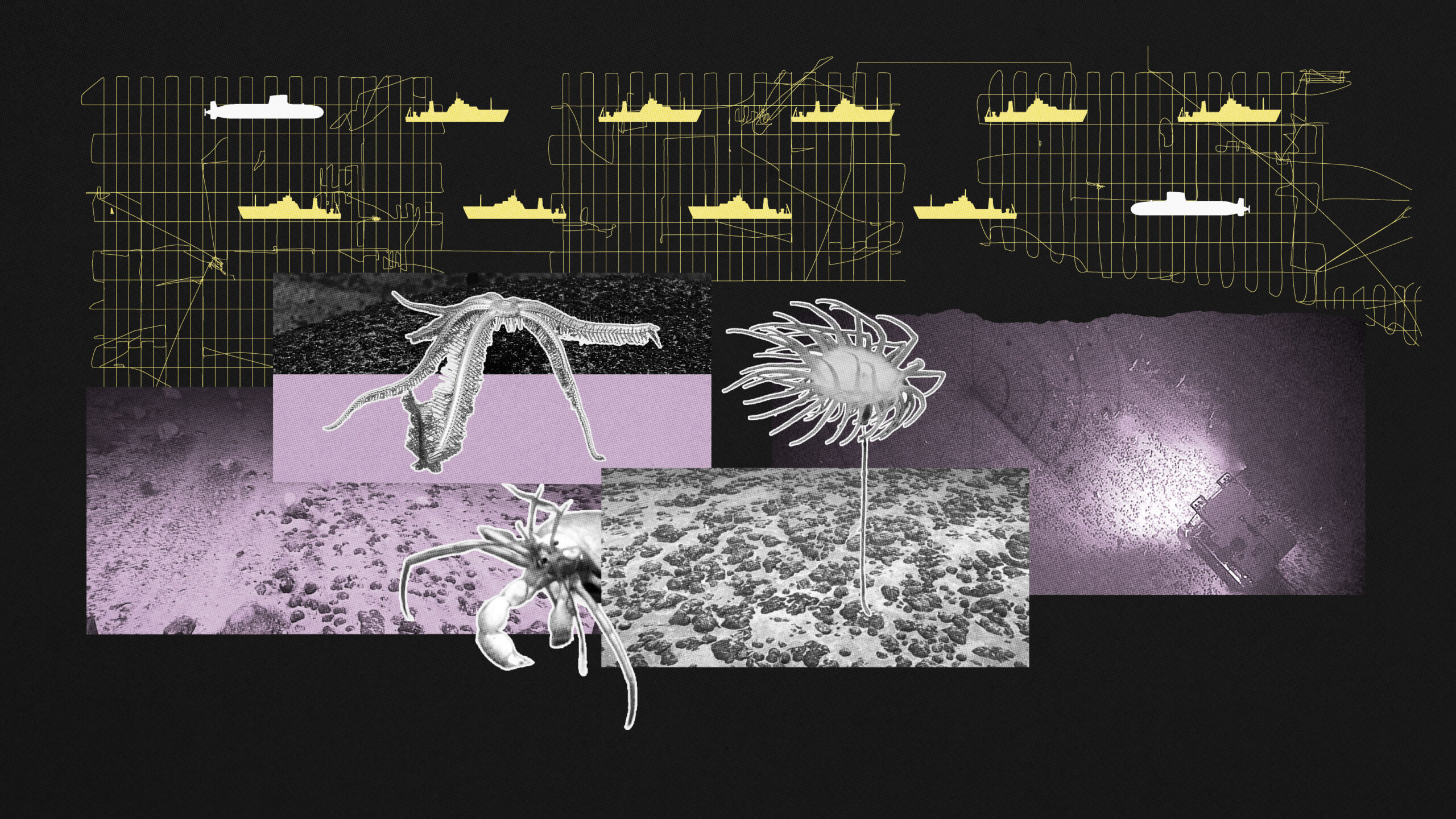
The research vessel Xiang Yang Hong 01 — "Facing the Red Sun" in Chinese — reached the site in June 2025. Four thousand metres below its hull, scattered across the abyssal plain like a giant's discarded marbles, lay polymetallic nodules: black, porous, each one the size of a fist and millions of years in the making. Inside them sits the architecture of modern power — cobalt for missile guidance systems, nickel for submarine batteries, manganese for the steel in aircraft carriers. The ship zigzagged overhead, instruments trailing. Officially, it was mining research.
It was not, for the most part, mining research.
Over five years, Mongabay and CNN tracked eight Chinese state-owned vessels assigned to deep-sea mineral exploration. They spent six percent of their time at sea anywhere near the areas China is licensed to survey. The rest — months upon months — they roamed waters of strategic consequence: past Guam, where American nuclear attack submarines berth; along Taiwan's eastern coast, tracing slow parallel lines as if recording the acoustic signature of the strait; into Russia's Avacha Bay, home to Moscow's Pacific submarine fleet. At intervals the ships went dark, cutting the identification beacons all vessels are required to broadcast.
"They want to know what's going on at the bottom of the sea," said Raymond Powell, a retired U.S. Air Force colonel who monitors China's maritime movements. "Where U.S. submarines might go, where their submarines might go."
China's Ministry of Foreign Affairs, asked about the voyages, did not address specific ships. It said China "highly values deep-sea environmental protection."
Alexander Gray spent Trump's first term on the National Security Council. He does not find the Chinese position persuasive. The vessels represent "a very real concern," he said, and China's grip on critical mineral supply chains amounts to "economic coercion." His prescription is blunt: the United States should mine the deep seabed itself.
The administration obliged. An executive order in April 2025 to accelerate offshore mining. A rule in January 2026 to fast-track licences. A twelve-billion-dollar fund. Plans near American Samoa, Alaska, the Northern Mariana Islands. A joint project with Japan to extract rare earths from the seabed beside a military base. The U.S. is not a member of the International Seabed Authority and has not ratified the Law of the Sea convention. When China protested that the seabed is "the common heritage of mankind," the State Department replied that the convention "has become a tool of malicious actors."
The contest found its proving ground in the Cook Islands — fifteen islands sitting on 6.7 billion tonnes of cobalt-rich nodules. China signed mining agreements in early 2025. New Zealand, the islands' traditional patron, cut aid in protest. Within months the FBI opened an office in Wellington; the U.S. issued a joint minerals statement with the Cook Islands; an American research vessel arrived for a seabed survey. A Chinese ship followed shortly after.
Here is the dilemma no official in either capital will state plainly. The nodules contain metals both nations consider essential — for weapons, for batteries, for leverage over the other. To leave them on the ocean floor is to accept dependence on your rival's supply chain. To extract them is to industrialise an ecosystem so poorly understood that a Chinese submersible expedition in 2021 found 7,500 species of deep-sea microorganisms, ninety percent of them unknown to science. A Nature study showed a single mining test site had not recovered its biodiversity after forty-four years. The creatures that cycle nutrients through the deepest food webs on Earth live among the very rocks both powers want.
Isaac Kardon of the Carnegie Endowment observed that Beijing "says nice things about the environment" but will not accept any findings that interfere with drilling. Emily Jeffers of the Center for Biological Diversity called America's plans "inviting an environmental disaster." Neither country's officials could explain how to mine the seabed without destroying what lives there. Neither seemed troubled by the question.
Alanna Matamaru Smith runs a conservation group on the Cook Islands. She has watched the ships come — American, Chinese, one after the other.
"These states don't care about us or the long-term environmental impacts they may leave behind. They only care about protecting themselves."
Below her islands, in the permanent dark, the nodules wait.
Adapted from:
 Andy Lehren