I Wasn't Aware We Needed Saving
I.
In the annals of imperial expansion, there is a recurring figure: the man of great energy and private fortune who arrives at the periphery of the known world and, finding it insufficiently organised, sets about remaking it according to his own vision. He builds. He restores. He improves. He is generous — genuinely so, often at extraordinary personal cost. He names things. He employs the locals. And because the locals have nothing else — because the economy that once sustained them has long since crumbled — they accept his employment, his gifts, and his plans with a gratitude that slowly, imperceptibly, becomes something closer to dependency.
The man was not always a hedge fund manager. He was once a tea planter, a railway engineer, a lieutenant-governor. But the pattern is remarkably stable across centuries and continents: private wealth enters a territory whose indigenous economy has collapsed, establishes itself as the primary employer and benefactor, and discovers — with apparent surprise — that gratitude and sovereignty cannot coexist for long.
II.
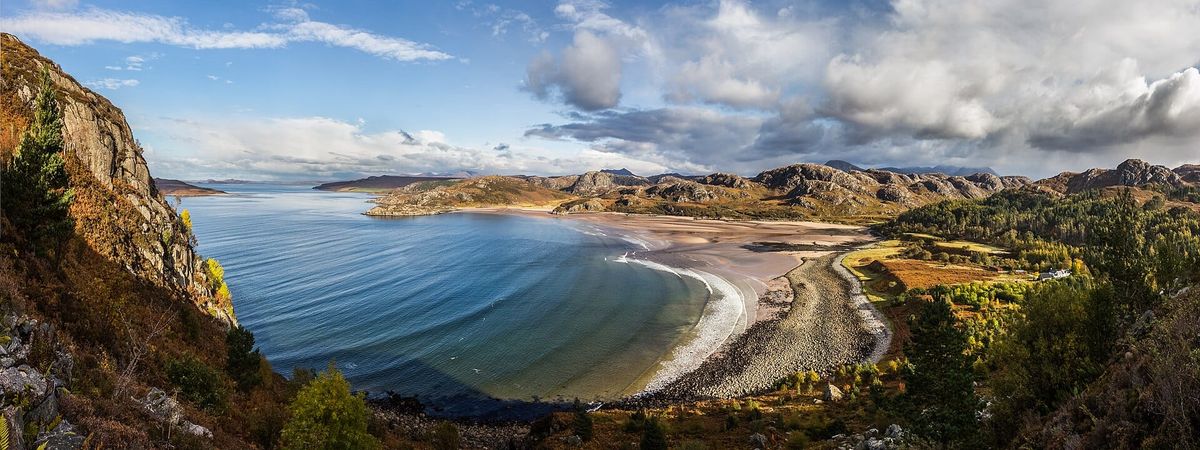
Coigach is a peninsula of two hundred and sixty-four people running twenty-five miles into the Atlantic from Scotland's northwest Highlands. The mountains along its flanks — Stac Pollaidh, Ben Mòr Coigach, and the extraordinary Suilven beyond — have names older than English. The population has halved since 1921. Fewer than ten of eighty-eight registered crofts are still farmed. The herring are gone. There is one hotel, and it is closed. There is one B&B. The nearest town is fifteen miles of single-track road away.
In 2017, Ian Wace, co-founder of Marshall Wace — a hedge fund managing over seventy billion dollars, which made £19.1 million in three days betting on Carillion's collapse — bought the island of Tanera Mòr, a mile off the Coigach coast, for £1.7 million. He said he felt sorry for it.
He then spent over one hundred million pounds rebuilding it. Forty ruins restored. A Lancaster bomber hangar shipped from Cheshire for a dining hall. Marble from the Savoy lavatories. Floorboards from Churchill's War Office. A cargo ship sunk and converted into a cinema. Victorian bathtubs. Underfloor heating. Everyone who works there or visits signs a non-disclosure agreement — to preserve, his team explains, "the mystique and magic."
The island now serves traumatised soldiers and exhausted public servants through one charitable channel, and ultra-high-net-worth individuals seeking "unique transformative experiences" through another. The juxtaposition is never remarked upon in the official literature.
III.
Then he crossed the water.
In 2024, when the Badentarbat Estate came up for sale, Wace moved before the community could organise a buyout. He offered to fund the local development company's purchase of the crofting land — announced as a gift — on condition that a decision be made in a single evening, at a meeting where residents voted by walking through separate doors in full view of their neighbours. A majority voted yes. Many did so reluctantly.
By autumn, Wace controlled the remaining eleven hundred non-croft acres, the only hotel, the Old Manse, a farmhouse, several residential properties, and a growing share of the peninsula's employment. He told The Scotsman that "Tanera the verb is a work in progress" — that you could say "we Tanera'd it." The island's name had become an ideology, extended across the mainland through a 172-page impact report dense with terms like "cascading impact" and "sustainability as a pillar of wholeness," but containing no independent assessment, no financial detail, and no dissenting voice.
IV.
On one side: a man of vast wealth and genuine passion, driven by personal tragedy — the loss of his first wife and two children in a 1994 car accident he witnessed in his rear-view mirror — toward a life of philanthropic action. There is no reason to doubt his sincerity. Sincerity, however, has never been the issue.
On the other side: two hundred and sixty-four people who were asked to make a consequential decision in a single evening under conditions that made dissent visible and costly, and who now watch as the infrastructure of their daily lives passes under the control of a single external actor whose plans are revealed to them but never shaped by them.
The asymmetry is not one of intentions but of power. When a gift cannot be refused — not because it is unwelcome, but because refusal means forgoing the only investment on offer — it is no longer, in any meaningful sense, a gift. This is the oldest dynamic in the history of unequal encounter, and no amount of vocabulary — restoration, wholeness, community, healing — alters its fundamental structure.
V.
Why should this matter beyond fifteen miles of single-track road?
Because Coigach is not an anomaly. It is a prototype.
In the coming decades, communities hollowed out by depopulation, ecological degradation, and economic collapse will face offers of salvation from actors wielding capital on a scale those communities cannot match. The language will vary — resilience, adaptation, regeneration — but the structure will be the same: resources flowing from centre to periphery on terms set exclusively by the centre, creating dependencies the periphery has no practical power to refuse. This is the pattern wherever hard resources meet soft communities, wherever the man with the capital arrives in the territory without options. It is the pattern that will define climate adaptation, rural regeneration, and post-industrial recovery across the world. The question is not whether the improver means well. The question is whether communities can retain any meaningful agency over the hard choices that will shape their futures — what gets built, who decides, what gets lost — when the only alternative to accepting the terms is accepting the decline.
The residents of Coigach have survived worse than Ian Wace. They have survived the Clearances, the death of the herring, the steady emigration of their young, and the long indignity of being considered picturesque by people who do not have to live there. One of them, asked about Wace's mission to save the peninsula, offered a remark that deserves to stand as the epitaph for every well-meaning intervention imposed upon a people who were not consulted:
"I wasn't aware that we needed saving."
The game continues. The mountains keep watch. The Atlantic keeps coming. And in a village hall at the edge of Europe, two hundred and sixty-four people walk through doors, choosing their future under the gaze of their neighbours, and hope that the man who felt sorry for an island will, in the end, feel something for them too.
Based on "A Laird for our Times: Questions of Philanthropy and Community in the Scottish Highlands" by Simon Murray, Bella Caledonia, 25 March 2026