Black Sands, Guerrillas and the Battle for Venezuela's Hidden Riches
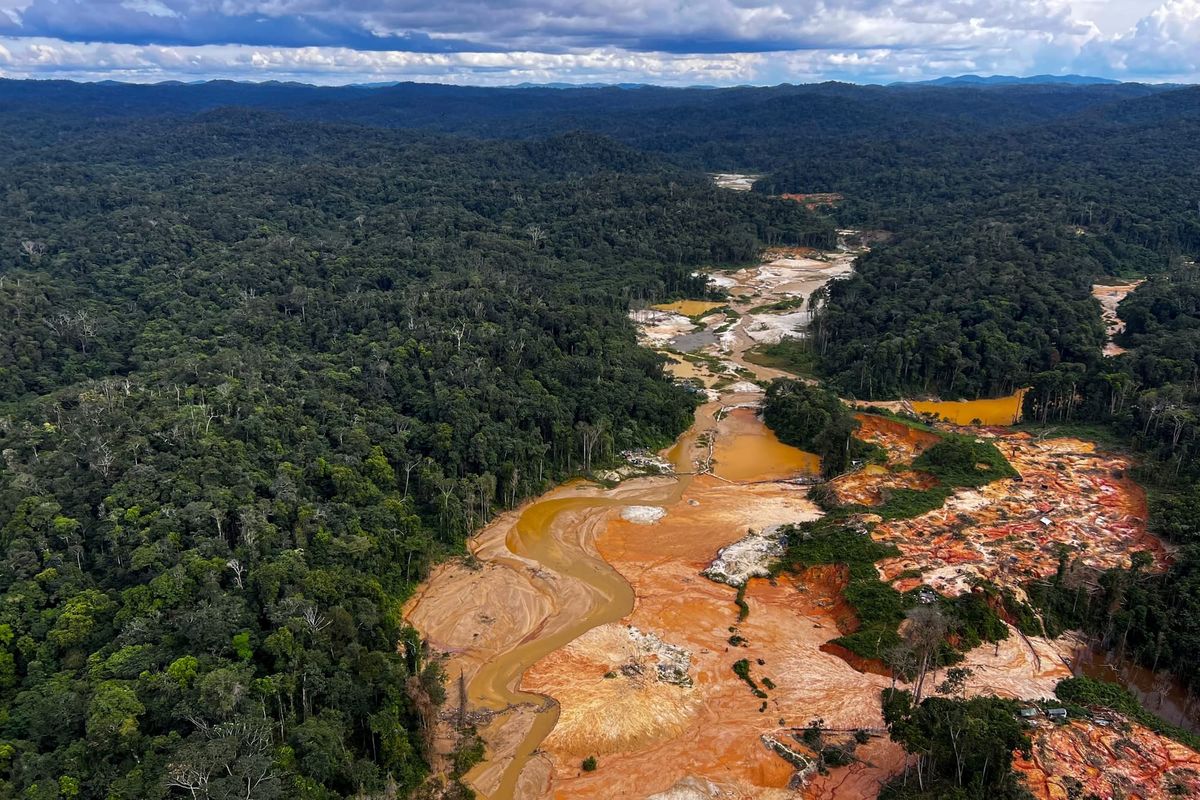
Somewhere in the green darkness of southern Venezuela, not far from where the Orinoco breaks into a thousand unnamed tributaries, several men stand in a clearing and pass blueish-black gravel from hand to weathered hand. They do not know — or perhaps they do, and simply cannot afford to care — that the coarse dirt trickling through their fingers contains traces of the most strategically contested elements on earth. Rare earths. The invisible architecture of missiles, wind turbines and mobile telephones. The currency of the coming century.
To reach this place, one must travel beyond roads, beyond law, beyond the writ of any government that might plausibly claim sovereignty. The jungle here belongs, in practical terms, to the National Liberation Army — the ELN — Colombian guerrillas who seized these mines in 2023 and have held them since with a grip that owes nothing to ideology and everything to profit. "Months later, they even brought in helicopters," one miner recalled. "Everything was chaos. They were taking the material away."
It is a scene that Peter the Great or Lord Curzon would have recognised at once: a vast, unmapped territory of staggering mineral wealth, fought over by rival powers and their proxies, while the people who actually live upon it are ground between the millstones.
When American forces seized President Nicolás Maduro on the third of January, the world's attention swung naturally to oil — those immense, tar-black reserves beneath Lake Maracaibo and the Orinoco Belt, the largest proven deposits on the planet. Oil was comprehensible. Oil had pipelines and tankers and a spot price that moved markets. Oil was the prize everyone could see.
But the shrewder players were already looking south.
Below the oil fields, stretching across the remote states of Bolívar and Amazonas, lies a geological treasury that has never been properly surveyed, let alone exploited on an industrial scale. Gold, certainly — the gold that had kept Maduro's bankrupt regime afloat for years, smuggled out through Colombia and the Caribbean in a shadow economy of spectacular corruption. But also cassiterite, the ore of tin, essential to every soldered circuit board on earth. Coltan, without which there are no semiconductors, no smartphones. And in the black sands of the riverbanks, rare earth elements — the same minerals over which the United States and China have been waging an increasingly undisguised struggle for supremacy.
It is, in short, the new Great Game. And like the old one, it is being played across terrain that its principal contestants have never visited, at the expense of people whose names they will never learn.
The day after Maduro was taken, the US Commerce Secretary, Howard Lutnick, could barely contain himself. "You have steel, you have minerals — all the critical minerals," he told reporters, with the air of a man who has just discovered an unguarded vault. "They have a great mining history that's gone rusty. President Trump is going to fix it and bring it back."
He offered no plan for how this miracle would be accomplished. He did not mention the guerrillas.
Within weeks, Maduro's replacement — Delcy Rodríguez, the former vice-president who had navigated the transition with a survivor's instinct — was meeting with mining executives, several of them American. She promised to unlock Venezuela's mineral riches at what she called "Trump speed." She announced plans to increase gold production by thirty per cent, alongside iron, bauxite and critical minerals. Shortly afterwards, the state mining company Minerven struck a deal to sell a full tonne of gold to Trafigura, the Swiss-based commodity trader that had already planted its flag deep in Venezuelan oil.
The speed was impressive. The due diligence was not.
To understand why, one must descend from the air-conditioned conference rooms of Caracas into the reality of the mining arc itself.
Maduro had designated 112,000 square kilometres of southern jungle as the "Orinoco mining arc" in 2016 — a grandiose gesture that existed primarily on paper. There were no geological surveys. No processing plants. No roads worthy of the name. What existed instead was an ecosystem of extraction that owed more to the nineteenth century than the twenty-first: miners dredging rivers from makeshift barges, digging shallow pits with shovels and bare hands, watched over by men with automatic rifles.
Thousands of these miners are Indigenous people — Yanomami, Ye'kwana, Pemón — driven into the economy by poverty so absolute that it makes the dangers seem secondary. The dangers are not secondary. Investigators from the research outlet Amazon Underworld, who reached the region in mid-2025, documented a catalogue of horrors: summary executions, forced labour, the recruitment of children, sexual violence. The ELN runs its mining operations with the administrative efficiency of a police state. There are prisons, with barbed wire. Punishments for insubordination. Restrictions on movement.
"They have a prison there, with barbed wire and everything," one miner said. "But you can't do anything about it, because if you do, they'll throw you in there, too."
It is here that the Great Game acquires its moral dimension — the dimension that distinguishes it from a mere contest of empires and makes it, instead, a test of whether the powerful nations of the earth can obtain what they need without destroying what they touch.
The gold trade had already laid waste to vast tracts of forest and poisoned rivers with mercury. But the scramble for rare earths is creating new and poorly understood dangers. Venezuelan environmental journalist Fritz Sánchez describes a landscape being torn apart by prospectors who have no notion of what they are digging up. "We don't know what disaster is coming, because everyone is searching for these rare earth elements, digging holes everywhere, making it look like a ravaged field."
Indigenous miners have reported skin burns, persistent joint pain, swollen joints — pathologies consistent with exposure to radioactive minerals. There are no clinics in these areas to document the damage. The evidence, like the minerals themselves, is carried away by hand, unrecorded.
And where does it all go?
The answer, as with so many threads in this story, leads to China.
Amazon Underworld's investigators traced the supply chain in two directions. Some of the ores cross the border into Colombia, where they are processed and exported under fraudulent customs codes — a laundering operation as brazen as it is effective. The rest is sold to collection hubs established by the Venezuelan Mining Corporation, a state company, and shipped directly. Export documents and testimonies indicate that by both routes, the minerals overwhelmingly reach Chinese industrial hubs.
China controls ninety-one per cent of global rare earth processing. This is the strategic reality that keeps Pentagon planners awake at night and drives the Trump administration's interest in Venezuelan minerals with an urgency that borders on compulsion. "The US wants to prevent China from accessing these resources," says Bram Ebus, director of Amazon Underworld. "But they also want access themselves."
It is the oldest dilemma of the Great Game: how to deny your rival a prize that you covet for yourself.
The Americans are moving with a pragmatism that would have impressed Palmerston. On the sixth of March, the US Treasury's Office of Foreign Assets Control issued a general licence authorising certain transactions in Venezuelan gold — effectively opening a door that Washington's own sanctions had locked shut. Minerven, the very company that the United States had sanctioned in 2019 for illegal practices, was now being introduced to corporate investors by the same government that had condemned it.
"It's remarkable," Ebus observes, "that Washington sanctioned Minerven for illegal practices, watched it fail to change its behaviour, and is now introducing corporate investors to it."
David Soud, of the consulting firm IR Consilium, is less surprised. "They did it with the oil," he notes, "where Ofac issues a limited licence in an otherwise heavily sanctioned environment." The pattern is familiar: strategic necessity bends the arc of policy.
But there is a complication that even the most flexible policy cannot easily accommodate. The ELN — the guerrilla army that controls many of the richest mines — is designated by the United States as a terrorist organisation. Any company sourcing minerals from ELN-controlled territory risks being accused of financing terrorism. It is one thing to look the other way at murky supply chains; it is another to write cheques to groups on the State Department's blacklist.
"I think what's more plausible," Ebus suggests, "is that the US will buy from Venezuelan state companies and then refine in the US, and basically pretend they don't know it's coming from illegal mines."
Pretend they don't know. It is a phrase that echoes down the corridors of every Great Game ever played.
For environmentalists and champions of good governance, the situation presents choices of agonising difficulty.
The minerals in Venezuela's black sands are not trivial luxuries. They are essential components of the renewable energy technologies upon which any serious response to climate change depends. Wind turbines require neodymium. Electric vehicles require lithium and cobalt. The entire apparatus of decarbonisation runs on rare earths. To refuse these minerals on ethical grounds is to slow the energy transition. To accept them is to become complicit in deforestation, forced labour and the poisoning of Indigenous communities.
"Illegal mining in Venezuela is not only devastating Indigenous communities and fragile ecosystems," says Emily Iona Stewart of Global Witness, "but also eroding the stability of mineral supply chains, which are central to the energy transition."
The call from organisations like Global Witness is for full supply chain transparency, enforcement of existing sanctions and due diligence laws, and meaningful investment in community-led alternatives. These are reasonable demands. They are also demands that have been made, in various forms, about various mineral rushes, in various parts of the world, for the better part of two decades — with results that are, at best, mixed.
On the ground, the situation is starker. "There's no government programmes, no health, no education," says Cristina Burelli of the NGO SOS Orinoco. "If you're really going to tackle illegal mining, you have to provide alternatives to these thousands of impoverished people."
Fuel, she reports, is flooding into the mining areas — the indispensable lubricant of extraction. When Rodríguez announced her production targets, it was received in the jungle not as policy but as permission. Keep doing what you're doing.
And so the Game continues, as it has always continued: great powers manoeuvring for advantage over resources they regard as vital, local populations caught in the machinery, and the land itself — ancient, fragile, unmapped — bearing the cost.
In the drawing rooms of Washington and Beijing, men and women study charts of global rare earth supply and speak of strategic autonomy and critical mineral security. In the jungle of Bolívar state, a miner with burned skin and swollen joints passes a handful of black sand to a trader, who passes it to a smuggler, who passes it across a border, who sells it to a broker, who ships it to a port, where it enters the gleaming supply chain of the twenty-first century and becomes, at last, invisible.
The old gold is running out. "Now people are working mostly on these things," one Indigenous miner told Amazon Underworld. "Black sands, tin, coltan."
The New Great Game has begun. Its outcome will be determined not in the capitals where the decisions are made, but in the unmapped places where the consequences are lived. Whether the world's democracies can find a way to secure the minerals they need without perpetuating the violence and exploitation that currently produce them is, perhaps, the defining question of the energy transition — and one to which, at present, no honest answer is forthcoming.